Course I · 30 ft1883 – 1901Warm Springs Creek
A town drawn on paper
Daly needed water, flat ground and room to burn. He found all three on Warm Springs Creek, 26 miles west of Butte.
In 1883 Marcus Daly had a problem most mining men would envy. His Anaconda mine in Butte was turning out copper ore faster than anyone could smelt it. Backed by the San Francisco syndicate of George Hearst, James Ben Ali Haggin and Lloyd Tevis, he went looking for a smelter site with plenty of water, and found it in the Deer Lodge Valley along Warm Springs Creek.
On June 25, 1883, Daly filed a town plat. He wanted to call the place Copperopolis, but another Montana camp already had that name, so the town took the name of the mine. Smelter construction started that summer, and people arrived faster than houses could go up.
The first plant, later called the Upper Works, went into operation in 1884 with five times the capacity of any smelter in Butte. A second, the Lower Works, followed in 1889. Together they made Anaconda the largest smelting center in the world, and the town grew up in their smoke.
The jobs drew immigrants by the thousands. Many were Irish, like Daly himself; others came from all over Europe. Most settled in Goosetown, a working-class neighborhood beside the foundry and the old works, close enough to walk to every shift.
- Plat filed
- June 25, 1883
- Name he wanted
- Copperopolis (taken)
- Upper Works
- Fired 1884
- Lower Works
- Fired 1889
- Population
- 700 in 1880 · 3,975 in 1890 · 9,453 in 1900
The grid below the hill
Daly's townsite from the western hills. The reduction works and the stack sit on Smelter Hill at the far right. Historic American Buildings Survey, Library of Congress.
Course II · 90 ft1889 – 1900The capital fight
The capital that almost was
Daly wanted more than a company town. He wanted the seat of government.
Montana became a state in 1889, with Helena as its temporary capital. That same fall Daly started a newspaper. The first Anaconda Standard came off the press on September 4, 1889, run by John H. Durston, a Syracuse publisher and philology professor Daly hired to give it polish. It became one of the best-funded dailies in the West, and Daly's voice in every political fight.
Daly built the Montana Hotel on Main Street to impress visitors, and had a wooden portrait of his champion racehorse, Tammany, inlaid in the barroom floor. Nobody was allowed to walk on it.
The legislature left the permanent capital to the voters. Seven towns ran in 1892. None won a majority, so the top two, Helena and Anaconda, went to a runoff in 1894. Daly's old rival William A. Clark backed Helena. The two camps spent somewhere between $1 million and $2 million on parades, fireworks, badges and favors. Helena called Anaconda a company town that Daly owned outright. Anaconda answered that Helena had no real economy.
Helena won by 1,906 votes. Clark reportedly bought drinks for the town that night at a cost of $30,000. Five years later the legislature sent him to the U.S. Senate amid charges of bribery, and Daly's paper drew him as a man who bought his way in.
Official returns · Montana capital question
Anaconda lost by 1,906 votes
Course III · 160 ft1900 – 1945Washoe Reduction Works
The works on the hill
Daly did not live to see it fired. When the Washoe opened in 1902, it was the largest copper smelter on the planet.
By the late 1890s the Upper and Lower Works were worn out and too small for the flood of Butte ore. Daly began an immense new plant on the hill across the valley from town. In 1899 he sold his company into the Amalgamated Copper trust for $39 million, and in November 1900 he died in New York. The Washoe Reduction Works was finished in 1902, and the old works on Warm Springs Creek shut down.
The ore came from Butte on the Butte, Anaconda & Pacific Railway, which Daly had founded in 1891 so that no outside railroad could set his freight rates. At the Washoe it was crushed and concentrated, roasted, melted down to a copper-iron matte, and blown in converters until what poured out was blister copper, ready for the refinery.
The plant opened with a capacity of 4,800 tons of ore a day. At its wartime peak in the 1940s it handled 15,000 tons a day, and the company's foundry and machine shops filled the flats below the hill. People called it the Washoe, the smelter, or just "the works."
From Butte rock to blister copper
Down the line
- Ore trainButte to Anaconda
Ore cars run 26 miles on Daly's own railroad, the BA&P.
Cold rock - ConcentratorCrush & float
Rock is crushed and the copper minerals are separated from waste.
Wet mill - RoasterBurn off sulfur
Concentrate is roasted. Sulfur and arsenic go up the flues.
Smoke begins - ReverberatoryMelt to matte
Furnaces melt the charge. Matte sinks; slag floats and is tapped off.
Molten - ConverterBlow with air
Air blown through the matte burns out iron and sulfur.
Sparks - Blister copperShip it out
Nearly pure copper is cast and sent on to the refineries.
Wire for a nation
"The largest of its kind in the world"
The new Washoe Reduction Works three years after start-up, before the Big Stack, when smoke still left the plant through several shorter stacks.
Night shift · the slag dump
Pour the slag
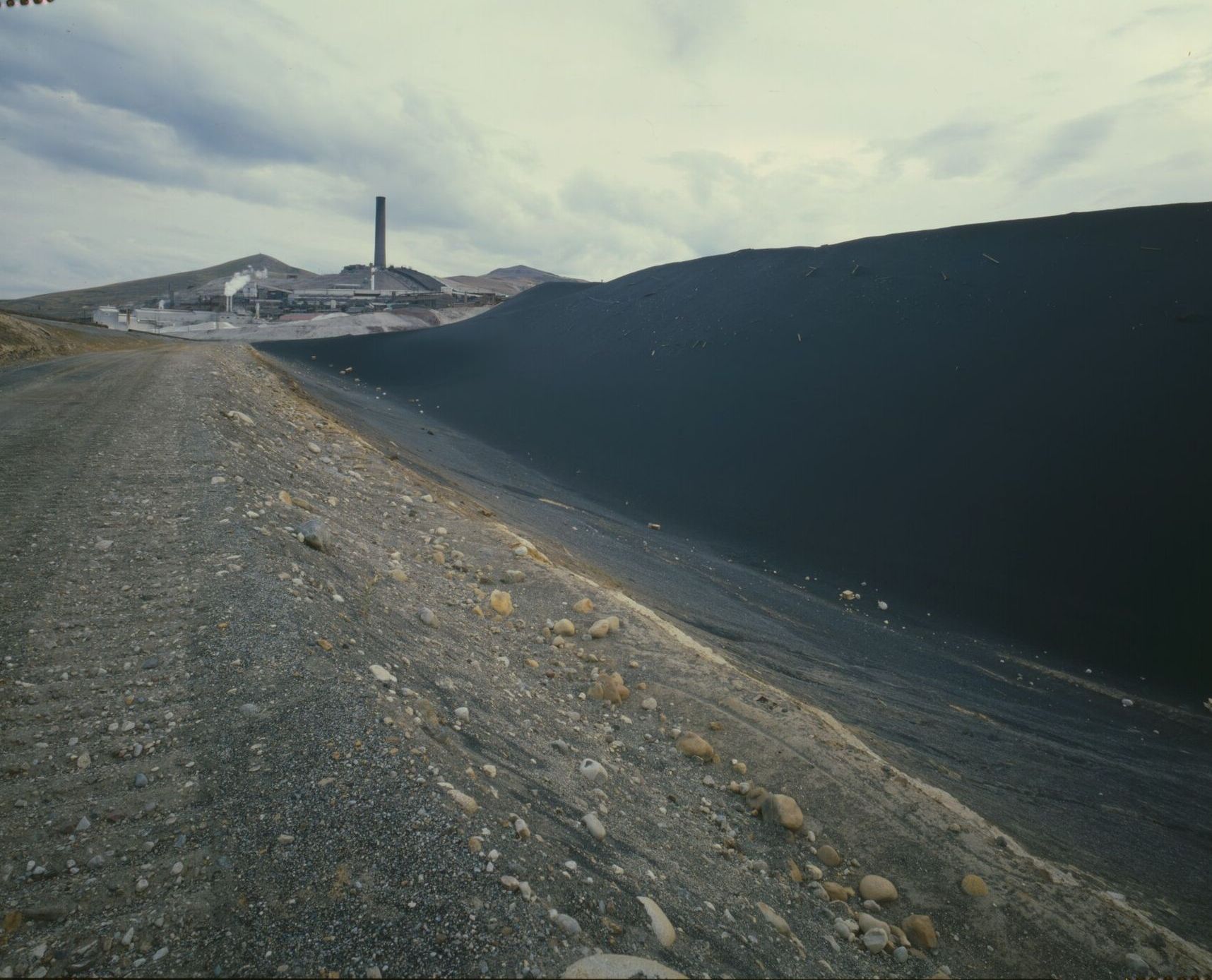
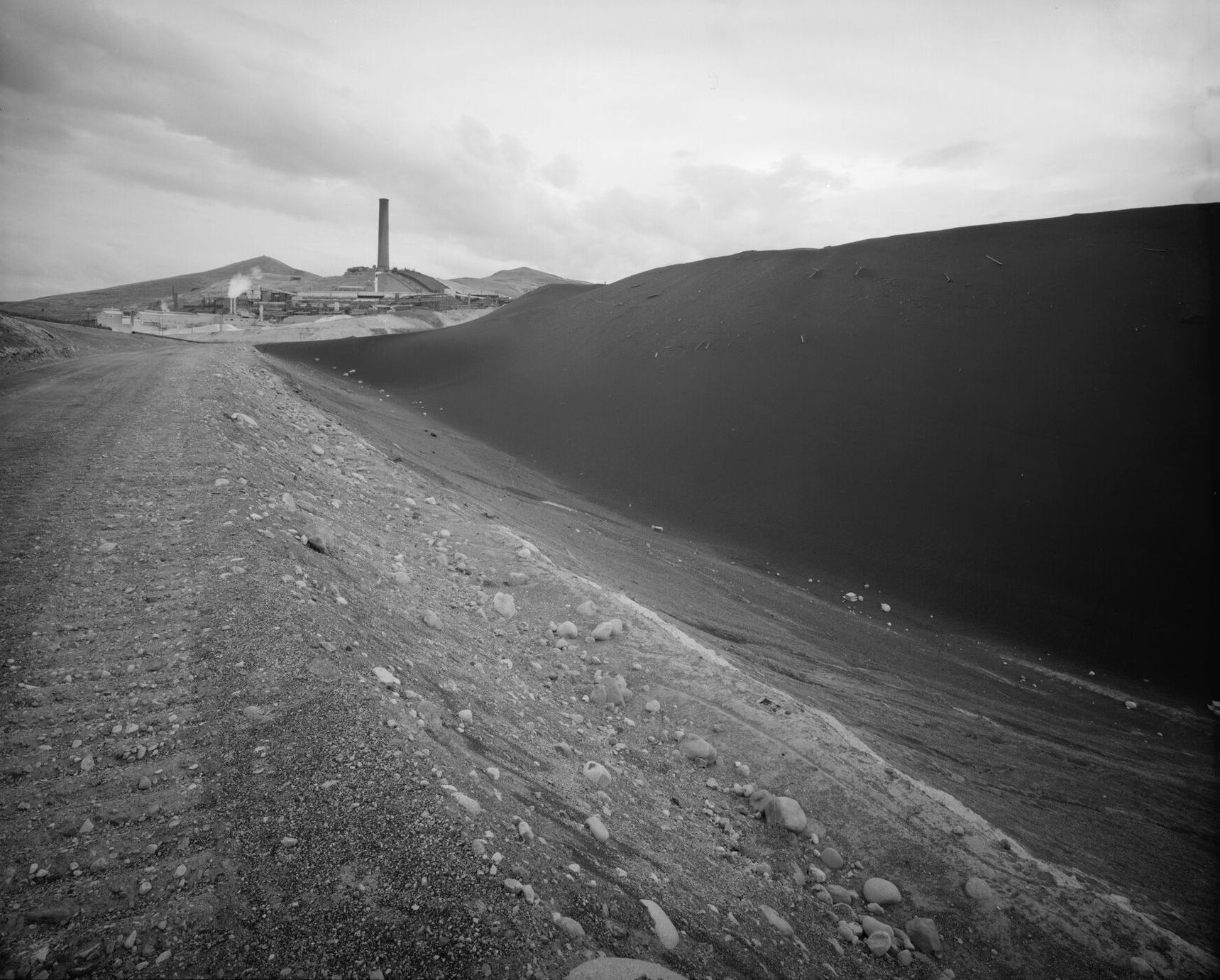
Copper was the small part. Most of what went into the furnaces came out as slag, molten rock that floated on top of the matte. It was tapped into iron slag pots, hauled out by rail and dumped while it still glowed. Pot by pot, for almost a century, it built the black hills along the highway between Anaconda and Opportunity.
Course IV · 270 ft1902 – 1925Deer Lodge Valley
The smoke zone
What went up the stacks came down on the valley.
The Washoe's flues and stacks threw sulfur and arsenic over the Deer Lodge Valley. Within months of the 1902 start-up, ranchers downwind were complaining that their crops were failing and their cattle, horses and sheep were sickening and dying. In 1903 the company began building new flues and a taller stack.
It was not enough. Late in 1904 about 100 farmers, roughly half the residents of what they called the smoke zone and owners of more than 50,000 acres, formed the Deer Lodge Valley Farmers' Association. On May 4, 1905, one of them, Fred J. Bliss, sued to shut the smelter down for good.
The case ran nearly four years. Federal investigators from the Department of Agriculture came to collect soil, water and forage. In January 1909 Judge William H. Hunt refused to order the works closed, and that April he declined to dictate how the plant should be run.
The damage outlasted the lawsuit. A later Agriculture Department bulletin found that in 1910 and 1911 the major tree species were dead or dying as far as 5 to 8 miles from the smelter. In 1918 the company raised a stack tall enough to carry smoke high over the valley, and from 1923 Cottrell electrical precipitators began pulling tons of arsenic out of the smoke stream.
Dashed rings: the 5-to-8-mile band where the U.S. Department of Agriculture found trees dead or dying in 1910–11. Turn the wind to see how the plume could reach any part of the valley.
Course V · 330 ftMay 23 – Nov 30, 1918Smelter Hill
Raising the Big Stack
Built in 191 days, in the last months of a world war, by a chimney company from New York.
Work began on May 23, 1918. The Alphons Custodis Chimney Construction Company of New York, which specialized in tall brick chimneys, topped it out on November 30, nineteen days after the armistice ended the First World War.
The stack stands on a concrete foundation 30 feet tall on its downhill side. The brick chimney above rises 555 feet, about six inches taller than the Washington Monument. Its flue is 76 feet across at the bottom and 60 feet across at the top. It took 2,464,652 perforated tile bricks and weighs 23,810 tons.
The bricks were made locally: perforated tile bricks, most of them curved to fit the round wall, each about 2.7 times the size of an ordinary brick. When new, the red brick chimney was covered with a gray terra cotta coating. By the time the smelter closed, the coating had worn off the lower part, exposing the brick and the steel bands that ring the stack. What survives on the upper 40 percent has weathered far darker than the brick, which is why the top of the stack looks black from town.
It went into service on May 5, 1919, drawing the smoke of the whole works up through the flues and the electrical dust treaters at its foot. It was then the tallest masonry structure in the world. Today it is the tallest one still standing anywhere.
Lay it course by course
Every flue led here
A year after first smoke. The treater buildings at its foot caught dust from the smoke before it went up the stack.
Course VI · 460 ft1898 – 1970sMain Street
Smelter City
Three shifts on the hill, and a town built to match.
For most of a century Anaconda lived by the smelter whistle. The census climbed to 12,494 in 1930. Men walked or rode the streetcar up to the works for three shifts a day, and the town below filled with churches, lodges, union halls and saloons. Goosetown, below the old works, stayed the heart of the immigrant town.
Daly's partners left their mark. Phoebe Hearst, widow of George Hearst, gave the town a library. The Hearst Free Library opened on June 1, 1898, stocked with books and art she paid for. In 1907 the state built its first fish hatchery in Washoe Park, with help from the smelter, whose manager sat on the Fish and Game Commission. It still raises trout.
In 1913 the BA&P strung wire over its main line and switched to electric locomotives from General Electric, running at 2,400 volts, the highest voltage then available. The electric ore trains ran between Butte and Anaconda until 1967.
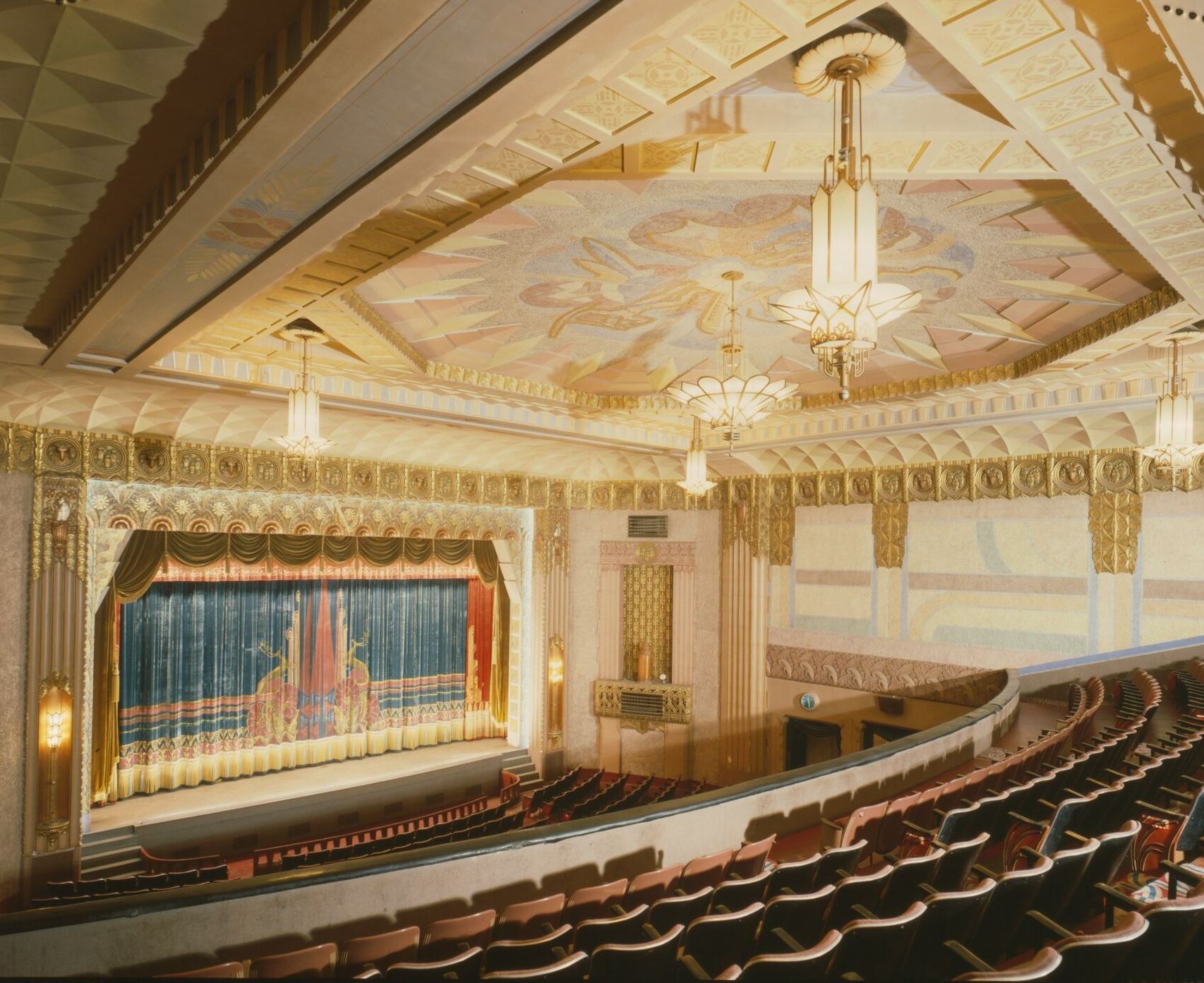
Then there was the Washoe Theater. Seattle architect B. Marcus Priteca designed it in 1930, but the Depression stalled the work, and it did not open until September 24, 1936. Nat Smythe's interior is finished in copper, silver and gold leaf; carved rams' heads line the walls and every flat surface is painted. It was the last theater built in the United States in the Nuevo Deco style, and the Smithsonian has named it a national treasure.
U.S. Census · Anaconda, 1880 – 2020
One brick, five hundred people
Each brick is 500 residents. From 1980 on, the count covers the consolidated Anaconda–Deer Lodge County, formed in 1977.
Still showing
The 1936 theater still shows films on Main Street, its copper-and-gold interior intact.
Course VII · 520 ft1977 – 1987Last heat
The fire goes out
On Monday, September 29, 1980, the company said the smelter would not reopen.
The Atlantic Richfield Company, ARCO, bought Anaconda Copper on January 12, 1977, years after Chile had nationalized the company's richest mines and just as copper prices sagged. The Washoe was old, and new state air-quality rules demanded far cleaner smoke. ARCO said the smelter could not meet them even if it spent $200 million.
The smelter and the company's Great Falls refinery had been idle since a strike that July. On September 29 ARCO announced that neither would start again. About 1,000 people lost their jobs in a town of about 10,000. After almost a hundred years, the furnaces on Smelter Hill went cold.
The Washoe was torn down in the years that followed. When the stack was threatened too, residents formed Anacondans to Preserve the Stack. They won. In 1986 the stack became Anaconda Smoke Stack State Park, and in 1987 it was listed on the National Register of Historic Places.
Course VIII · 560 ft1983 – todayAnaconda–Deer Lodge County
In daylight
A Superfund site, a golf course with black bunkers, and a stack you can see from everywhere in the valley.
In 1983 the Environmental Protection Agency listed some 300 square miles around the smelter as the Anaconda Smelter Superfund Site. A century of work had spread more than 260 million cubic yards of tailings, slag and flue dust over 20,000 acres. For four decades the cleanup has capped waste, replanted scorched hillsides and replaced contaminated soil in town yards. A 2023 agreement laid out the work to finish it.
The strangest piece of that cleanup is Old Works. Jack Nicklaus designed an 18-hole course on the ground of Daly's first smelter, and it opened in 1997. Its bunkers are filled with black slag. At the opening exhibition that July, Nicklaus shot a 70 in front of about 3,000 people.
In 1977 the city and Deer Lodge County merged into one government. In 2006 Anaconda joined Butte in an expanded National Historic Landmark district, tied together by the old BA&P roadbed. The 2020 census counted 9,421 people. The Washoe still shows movies, the Hearst library is still open, and the stack is still the first thing you see.
Still standing
The stack itself is closed to the public because the soil around it still holds arsenic and heavy metals. The state park viewing area below is the place to see it.
Anaconda, Montana · Common questions
Questions about Anaconda
Why was Anaconda built?
Marcus Daly founded it in 1883 as the smelter town for his Anaconda mine in Butte. He needed water and space for a large smelter, and found both on Warm Springs Creek in the Deer Lodge Valley, 26 miles west of Butte. He filed the townsite plat on June 25, 1883.
How tall is the Anaconda Stack?
585 feet overall, counting a 30-foot concrete foundation. The brick chimney itself is 555 feet, about six inches taller than the Washington Monument. It was built in 1918 with 2,464,652 bricks and is the tallest masonry structure still standing in the world.
Why is the top of the stack black?
When it was new, the red brick chimney was covered with a gray terra cotta coating. Over six decades of smelter smoke and Montana weather it wore off the lower part of the stack, exposing the red brick and steel bands. The coating that remains on the upper 40 percent has weathered much darker than the brick, so the top of the stack looks black.
Can you visit the stack?
You can see it from Anaconda Smoke Stack State Park's viewing area, but the stack itself is closed to the public because the surrounding soil is contaminated with arsenic, copper, cadmium, lead and zinc.
Did Anaconda almost become the state capital?
Yes. In the 1894 runoff Helena beat Anaconda 27,024 votes to 25,118, a margin of 1,906. The fight between Marcus Daly, who backed Anaconda, and William A. Clark, who backed Helena, cost the two sides an estimated $1 million to $2 million.
When did the Anaconda smelter close?
The smelter had been idle since a strike in July 1980. On September 29, 1980, ARCO announced it would not reopen. About 1,000 people lost their jobs. The Washoe smelter was later demolished; only the stack was saved.
What are the black hills and black sand near town?
Slag, the glassy waste left after copper was smelted. It was dumped near the smelter for almost a century, and the piles along Montana Highway 1 are part of the Superfund site. The bunkers at the Old Works golf course are filled with it.
Course log
Anaconda timeline
Marcus Daly files the townsite plat on June 25.
The first smelter, the Upper Works, begins operating.
Lower Works built. The Anaconda Standard first published, September 4.
Butte, Anaconda & Pacific Railway founded.
Helena beats Anaconda for state capital, 27,024 to 25,118.
Hearst Free Library opens, June 1.
Daly sells into Amalgamated Copper for $39 million.
Marcus Daly dies in New York, November 12.
Washoe Reduction Works begins operating.
Fred Bliss files the smoke suit, May 4.
State's first fish hatchery built in Washoe Park.
Judge Hunt refuses to close the smelter.
BA&P main line runs electric at 2,400 volts.
Big Stack built, May 23 to November 30.
Stack goes into service, May 5.
Washoe Theater opens, September 24.
BA&P ends electric operation.
ARCO buys Anaconda Copper. City and county consolidate.
ARCO announces the smelter will not reopen, September 29.
Anaconda Smelter Superfund Site listed.
Anaconda Smoke Stack State Park designated.
Stack listed on the National Register of Historic Places.
Old Works Golf Course opens.
Anaconda joins the Butte–Anaconda National Historic Landmark District.
You have reached the crown
585 feet.
Still standing.
Anaconda, Montana. Drawn on paper in 1883.
Photographs & sources
Most images here are in the public domain, from the Library of Congress (Historic American Buildings Survey and Historic American Engineering Record, John Margolies collection), the EPA, the Anaconda Copper Mining Company's 1920 publications and early technical books, by way of Wikimedia Commons. Three modern photos are used under Creative Commons licenses as noted.
- Plate IThe Big Stack and slag, 1979 · Jet Lowe, HAER, Library of Congress
- PortraitMarcus Daly statue, Montana Tech · Lyumars, CC0
- Plate IILooking east over Anaconda · HABS, Library of Congress
- Cartoon"The boss boodler is handy at it" · The Anaconda Standard, Oct. 28, 1900
- TammanyTammany, Daly's racehorse · The American Turf, 1898, via Internet Archive
- HotelMontana Hotel (Marcus Daly Hotel) · HABS, Library of Congress
- ConvertersConverters at the Washoe Works, c. 1920 · Anaconda Copper Mining Co.
- AerialWashoe Reduction Works from the air · U.S. Environmental Protection Agency
- Plate IIIThe Washoe Reduction Works, 1905 · Canadian Mining Review, via Internet Archive
- SlagPouring slag, Anaconda, c. 1912 · Donald M. Levy
- SmokeSmelter from the valley, 1908 · J. K. Haywood, USDA Bulletin 113
- CrownTop of the Anaconda stack · Tdewing, public domain
- StackThe Big Stack and the smelter · HAER, Library of Congress
- Plate IVMain stack and electrical dust treaters, 1920 · Anaconda Copper Mining Co.
- TheaterWashoe Theater from the balcony · Jet Lowe, HABS
- CeilingWashoe Theater ceiling · Jet Lowe, HABS
- RamsRam's head cornice · Jet Lowe, HABS
- BA&PBA&P electric locomotive, 1914 · General Electric Company
- LibraryHearst Free Library · HABS, Library of Congress
- Plate VWashoe Theater marquee, 2004 · John Margolies, Library of Congress
- 1979The Washoe smelter from the north · Jet Lowe, HAER
- Old WorksOld Works golf course and the stack, 2024 · Montanabw, CC BY-SA 4.0
- AerialThe Stack and slag, 2009 · Sam Beebe, CC BY 2.0
- Plate VIAnaconda smelter stack, 2007 · Banjodog, public domain
- FinaleThe Big Stack and slaghead · HAER, Library of Congress


_(18163183401).jpg)


_(14759224926).jpg)

_(14594824398).jpg)


.jpg)

Facts drawn from the Montana Historical Society's historic markers, the National Register nominations for the Anaconda Smelter Stack and the Washoe Theater, the Library of Congress record for the Anaconda Standard, Bliss v. Anaconda Copper Mining Co. (D. Mont. 1909), EPA Superfund fact sheets, Montana Fish, Wildlife & Parks, U.S. Census returns, and contemporary reporting by UPI and others on the 1980 closure.